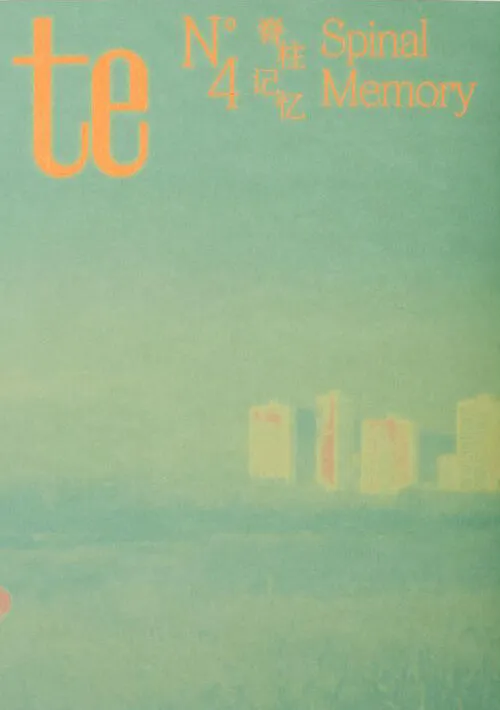
te issue 4: Spinal Memory
€ 38,00
In stock


The moment human fingertips lifted from the ground, upright walking became a privilege rather than a mere posture. The liberated hands could now be used to create tools for defense and hunting. The pupils’ gazes shifted from a level view to a downward perspective, a physical change that also translated into an awareness that overlooked other species. The spine, situated at the center of the human body, acts like a covert ruler, measuring the scale of evolution and supporting the illusion of being “human-centric.” Thus, humans stand, placing themselves far above all other creatures. Following this profound gestural revolution came the imagination and manipulation of non-human animals (the Others), turning them into livestock and companions, as their wildness was rewritten as docility. Their bodies became resources to be medicated and refined, transforming into instruments for milk and nutritious meat production. They became basic knowledge and research data, linking humanity’s ever-expanding and illusory colonial territories.
Discussions and attempts to understand often struggle to escape the limitations of human centrism. Trapped in a persistent ethical dilemma, we find it difficult to navigate the unequal power dynamics that confine us. As the urgency of environmental and ecological issues intensifies, a question repeatedly emerges: Is it possible for us to construct a relatively equal multi-species world? Can we, with greater humility and introspection, relearn how to coexist with the Others? This fourth issue does not offer answers; instead, it comprises reflections and imaginations, as most contributors have long-standing experiences with or ongoing research on non-human animals. Through observation, education, painting, writing, and image-making, they seek to loosen the existing “ethical relationships” and “orderly rules.” Returning to the interior of the body, each vertebra of the spine accumulates traces of human transitions and memories that have yet to dissipate. However, the spine has never fully completed its evolution; its flaws are evident, and the hidden pain it causes always accompanies the body. Perhaps it is this persistent pain that continually reminds us that suffering, which may seem unrelated to us, can be perceived anew from the fissure of spines. By stepping into the bodies of Others, to feel and acknowledge them, a slow exchange occurs that reopens our imagination and generates a relationship that has yet to be named.